Tuesday, August 10, 2010

Win an iPod Touch & Try the New BirdsEye "Lite" App


Simply by entering checklists into the eBird online database (www.ebird.org) birders have a chance to win an iPod touch® and a free download of the BirdsEye bird-finding application.

BirdsEye is the revolutionary iPhone app that harnesses the power of eBird to help users find the birds they want to see. It's not a traditional field guide for identification. It does what a traditional field guide cannot do: guide users to the places where birders are seeing birds, using fresh eBird data that are frequently updated.

BirdsEye has information about 857 species in North America, including eBird sightings, sounds from the Macaulay Library, photographs from VIREO, and birding-finding tips from Kenn Kaufman.

And now BirdsEye has a little brother: BirdsEye Lite. Designed for beginning birders, BirdsEye Lite features information about 135 species that are easy to find in North America north of Mexico.

“It’s a fantastic tool for new birders especially,” says Cornell Lab of Ornithology director John Fitzpatrick. “It helps users actually find birds, which is something even the best field guide can’t do.”

Designed for use on the Apple iPhone® and iPod touch®, BirdsEye and BirdsEye Lite are available on the App Store℠. BirdsEye Lite sells for $1.99 and BirdsEye sells for $19.99.


The contest takes place from August 16 through September 6. Anyone who signs up at www.eBird.org (it’s free) and submits at least one checklist during this three-week period will be entered in a drawing for the touch device and a free BirdsEye download. Five runners-up will get a free app download. For those already participating in eBird, anyone who submits checklists during the contest period will be entered in a separate drawing for another iPod touch and BirdsEye download. An additional five will also receive the app for free.

The BirdsEye Lite and BirdsEye apps were developed by Birds in the Hand, LLC, of Virginia, and bring together content from the Cornell Lab of Ornithology, the Academy of Natural Sciences, and author Kenn Kaufman.

Portions of BirdsEye and BirdsEye Lite sales go to the Cornell Lab of Ornithology to help support its research, education, and citizen-science projects focused on birds, and to the Academy of Natural Sciences to support VIREO, the world’s largest collection of bird photographs.


Contacts:
Todd Koym, Birds in the Hand, (434) 327-8533, tkoym@birdsinthehand.com

Pat Leonard, Cornell Lab of Ornithology, (607) 254-2137, pel27@cornell.edu

Apple, the Apple logo, iPod, iPod touch, and iTunes are trademarks of Apple Inc., registered in the U.S. and other countries. iPhone is a trademark of Apple Inc. App Store is a service mark of Apple Inc.
______________________________________________________________________

The Cornell Lab of Ornithology is a membership institution dedicated to interpreting and conserving the earth’s biological diversity through research, education, and citizen science focused on birds. Visit the Cornell Lab’s web site at http://www.birds.cornell.edu.

Monday, August 9, 2010

Hummingbird CRAZY!

Some folks are having GREAT success with their Hummingbirds!


Thank you Lynne Johnson for sending us this footage. AMAZING

Wednesday, July 7, 2010

Yummy Breakfast!

Looks like one of our resident hawks took down a pigeon this morning. I certainly do not begrudge them that. I'm just happy to know that it was an extremely well fed pigeon! :)

Thursday, July 1, 2010

Backyard Birds to be Impacted by Oil Disaster

Will the Gulf Oil Spill Affect Birds That Nest in Our Backyards?

NestWatch Needs Your Help

We've seen images of oiled pelicans, plovers, and other shorebirds and wading birds from areas affected by the recent spill. Species that nest on beaches and in coastal marshes, like plovers and terns, are being monitored by state wildlife officials. But many birds that nest in backyards all across North America, such as Red-winged Blackbirds and Tree Swallows, may winter in the coastal and marsh environments along the Gulf of Mexico where they could potentially be affected by the oil spill. We need your help to track nesting success of these birds in your own backyard and neighborhood.

Call for Data:

Birds passing through the Gulf region could carry contamination with them, creating an "oil shadow" of declines in bird reproduction hundreds of miles away from the coast. We need data for these key backyard bird species, all of which use the Gulf during some part of their annual cycle and could potentially be affected by the oil spill.

Click on the species name for additional life history information.

Northern Cardinal

Northern Cardinals are permanent residents in the coastal "cheniers," coastal ridge woodlands, in the Gulf region. Will the oil affecting the beaches and marshes impact birds of the coastal woodlands?

Red-winged Blackbird

Large flocks of Red-winged Blackbirds winter in marsh habitats along the Gulf. Blackbirds spend several months in coastal marshes before heading back north to nest.

Barn Swallow

Barn Swallows migrate past the Gulf of Mexico. These swallows roost in large flocks in marsh habitats during their annual journeys to and from wintering areas in Central and South America.

Purple Martin

Migrating Purple Martins pass through the Gulf of Mexico. They roost in large flocks in marsh habitats during their annual journeys to and from wintering areas in Central and South America.

Tree Swallow

Tree Swallows winter along the Gulf, relying on insects from coastal marshes and wetland habitats. Flocks of thousands of Tree Swallows can be seen along the Gulf Coast in winter, foraging over marshes when food is scarce.


This year's nesting season is already in full swing; it is critical to collect nesting data for these species this year and in the years ahead. Follow the NestWatch Code of Conduct and Nest Monitoring Protocol to help us track nesting success of these key backyard bird populations that may be affected by the Gulf oil spill.


Friday, May 21, 2010

Cute as heck baby Mockingbird!

Just found this little guy (along with a nestmate) back in the Holly bushes at the Goodlettsville store - couldn't for the life of me figure out why the parents were "CHACK"ing at me!

Friday, May 7, 2010

Tree Swallows


Tree swallows loving the boxes at my mom's home in Sparta, TN

Thursday, May 6, 2010

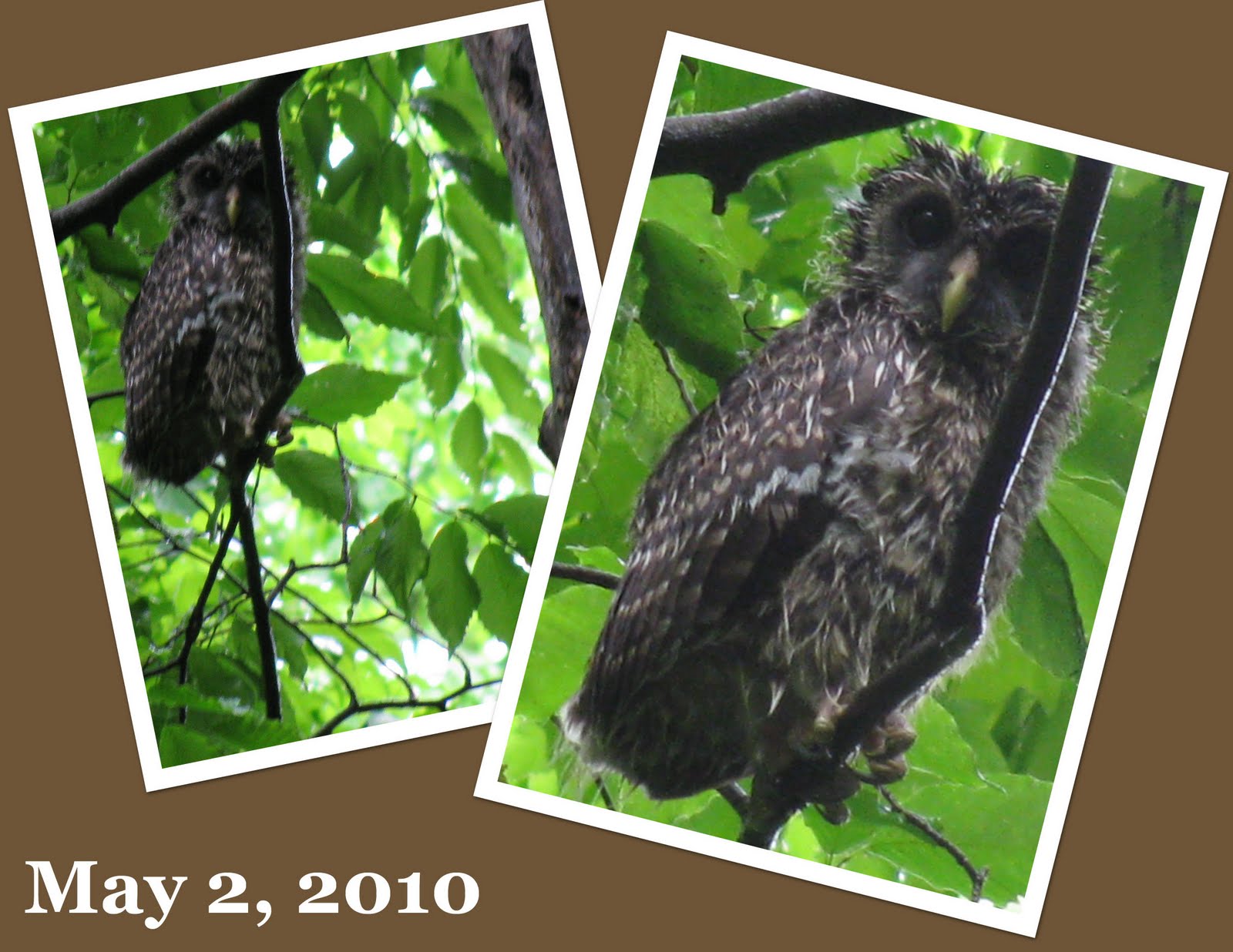
Very Wet Owlett

As some of you may know, Nashville experienced a rain last weekend like we have not seen in this area in 70 some years. At our home in Hendersonville, we received more than 15" of rain within 48 hours - unheard of!! Luckily for us, we live well up the ridge and halfway up a hill in a hollow. This location protects us from high winds and also from most of the impacts of heavy rain. Our front yard (near the road) was a river by Saturday night, and we were unable to leave our home due to the flooded creek.

Because of our inability to leave, we were also lucky enough to catch a glimpse of one of the Owletts that fledged 3 days earlier. This is the first time that we have ever seen live chicks after they have left the nest. We did, however only see one. I fear the worst for the other...

Anyway, here is the chick that we saw on Sunday....
He was VERY wet! Cute, but wet. :)


If there is any way that you can help with the recovery, either with money or volunteer time, consider doing so. Here is a great place to start.